
News Item
From Complaints to Change: Strengthening the Ombudsperson’s Legislative Role

- Issued on:
- Issued by:
- OSCE Project Co-ordinator in Uzbekistan
How can citizens’ complaints and human rights monitoring findings lead to better laws and stronger protection of fundamental rights? This was the key question explored at a two-day international training in Tashkent on “The Application of Legislative Initiative Powers by Foreign Ombudspersons”, held on 14–15 October 2026.
The training brought together staff of the Ombudsperson’s Office of Uzbekistan, its regional representatives and civil society organizations, with international experts sharing their experience and practical approaches to advancing human rights through legislative reform.
The event was organized by the OSCE Project Co-ordinator in Uzbekistan in co-operation with the Office of the Ombudsperson of the Republic of Uzbekistan and Centre for Development and Justice International (CDJI).
Opening the training, Ambassador Antti Karttunen, OSCE Project Co-ordinator in Uzbekistan, emphasized that the Ombudsperson’s constitutional mandate provided an important opportunity to transform recurring complaints and systemic gaps in human rights protection into concrete legislative proposals. He highlighted the importance of building on the institution’s day-to-day work to improve the legal framework, noting:
“Article 98 of the Constitution of the Republic of Uzbekistan provides the Ombudsman with the right to submit legislative proposals to Parliament. This is an important opportunity to build on the Ombudsman’s day-to-day work, including the complaints received and problems identified through monitoring, to highlight gaps in legislation and suggest practical ways to improve the protection of people’s rights.”
The programme explored international standards, including the Venice Principles and the UN Paris Principles, and European practices in strengthening the legislative role of national human rights institutions. International experts Anica Tomsic, Member of the UN Subcommittee on Prevention of Torture; Rhyannon Blythe, Director of the Northern Ireland Human Rights Commission; and Ger Deering, Ombudsman of Ireland, shared their expertise on drafting evidence-based legislative proposals and engaging with government institutions and parliamentary committees. Through practical exercises and a simulated parliamentary hearing, participants explored how to turn human rights findings into concrete legislative recommendations.
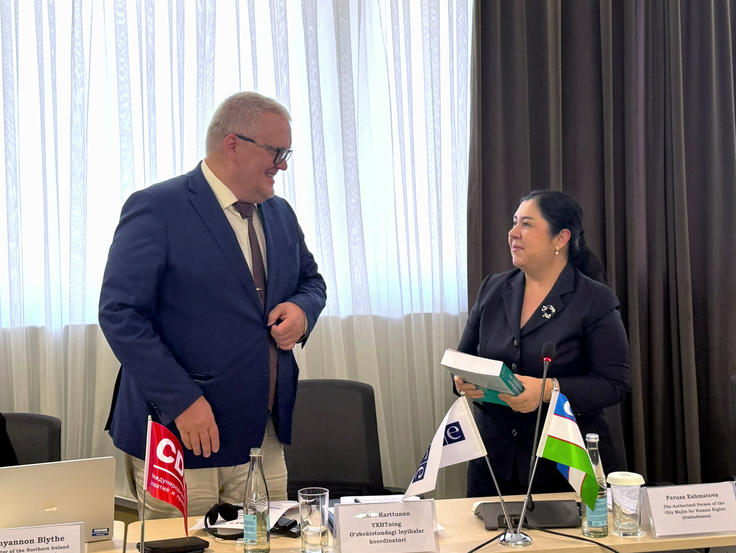
Antti Karttunen, OSCE Project Co-ordinator in Uzbekistan, hands over a collection of human rights publications to Feruza Eshmatova, Commissioner for Human Rights (Ombudsman) of the Republic of Uzbekistan, for the Resource Centre
The training builds on nearly two decades of co-operation between the OSCE Project Co-ordinator in Uzbekistan and the Ombudsperson Institution, which has supported institutional capacity-building and human rights protection since 2006. As part of this ongoing partnership, a collection of publications on human rights was handed over to the Ombudsperson’s Resource Centre to further support professional development, knowledge-sharing and continued learning.
Overall, the training contributed to enhancing the Ombudsperson Institution’s capacity to identify legislative gaps, and translate findings from complaint-handling and human rights monitoring into evidence-based legislative proposals to address systemic shortcomings and strengthen the legal framework for the protection of fundamental rights and freedoms.
Contacts
Contact
